
Which isn’t much, but here’s a little background. SA makes a wide range of wines but has only begun professionalizing and exporting in the last 10-15 years. They are best known for Shiraz, Southern Rhone-style Mouvedre blends, and the Pinotage grape, where they are a leader in this tiny segment. Prices range from pretty cheap – under $10 – to pretty pricey – the best stuff is $35 to $50. We have a range represented here. The only thing I know about the regions is that Stellenbosch is their Napa.
My tasting group BAWDY (Bay Area Wine Drinkers-and-a-Y, in the San Francisco area) tasted these wines in late 2006. More recent versions of each of these wines should be readilyi available at your local Beverages and More in the U.S.
1. Sauvignon Blanc Blend – NEDERBURG “LYRIC”, Saug Blanc 60%, Chenin Blanc 21%, Chard 19%, Paarl region, 11.5%, $13.
A pretty if unusual blend of whites. Turned out to be an interesting, full-bodied white.
2. Shiraz - FAIRVIEW JakkalsFontein region 2002 14.5% $35 discounted to $24
Wow; seems like a lot for a Shiraz, doesn’t it? But that’s okay – they knocked it down to only 3x what an Australian shiraz would cost. Is it worth the markup? You be the judge! It was good, but probably not $24 good….IMHO
3. Cabernet Sauvignon – LONG NECK, Western Cape Region, 2003, 14.0%, $7!
Seven bucks?? Definitely worth it. Full and round.
4. Southern Rhone Style – THE WOLFTRAP, Cape of Good Hope, Syrah 65%, Cinsault 19%, Mourvedre 11%, Viognier 3$, 14.0%, $10 – 91 points/Wong.
It’s only ten bucks, but BevMo buyer Wong gives it 91 points – jeez! Syrah-Mourvedre-Grenache is the basic Rhone starting point; this substitutes Cinsault for Grenache, and adds Viognier, a white, for aroma. We split on these two Rhones – half liked the Wolftrap, the other half liked the Goats DR, below! I liked the Wolftrap best, but I don’t think either of these had the classic Southern Rhone aromas and flavors, not fully, anyway…
5. Southern Rhone Style – 'GOATS DO ROAM – in Villages,' Paar. 2004 14.5% $11
Blend not given, but the pun on “Cotes du Rhone” suggests a Grenache-Syrah-Mouvedre (GSM) blend. Goats do Roam is a joke name, but this export brand sells a lot of Rhone-style blends in the US at low prices. Let’s see what it tastes like, especially compared to the equally inexpensive but highly rated Wolftrap.
6. Pinotage – LANZERAC, Stellanbosch Pinotage 2002 13.5% $25
Pinotage, not to be confused with Meritage in California, is a distinct French grape which has never gone anywhere, but some California and even more South African winemakers have been experimenting, convinced it can make a well-built wine. Let’s see if they’ve broken the code! Pinotages are pricey, though! This was nice!
7. Bordeaux Blend – UMKHULU -- “The Big One” – “Tian” blend, 2001, Stellenbosch, Cab 67%, Merlot 15%, Cab Franc 11%, Malbec 7%. Vino Venue approx $30.
Serious stuff, at serious prices; Umkhulu is Swahili for “The Big One,” and I don’t know what "Tian" means. Big indeed! This could easily have aged a year or three!
Saturday, April 26, 2008


The Charles Shaw "Two-Buck Chuck" 2003 California Merlot is ready to drink!
The Charles Shaw "Two-Buck Chuck" 2003 California Merlot is ready to drink!
I just cracked open a bottle from my case of Charles Shaw 03 Merlot and am here to tell you that it's *ready*, baby!
The wine is mild, with a nice fruit. There's a hint of green to it, which I don't like, but it's very drinkable. If you put away a case of this cheap stuff back then, now's the time to break it out -- and I'm guessing from how it's tasting now that it won't last much longer.
Background: Like many of you, I've tipped a few glasses of the notorious $2 Buck Chuck (it's even made it into Wikipedia), a line of wines that sell at the Trader Joe's grocery chain for $1.99 the bottle -- and at $24 the case (12 bottles) that's one tempting opportunity.The brand became famous (and even infamous, as this entry in Snopes.com's Urban Legends page testifies) for its initial run of cheap but very tasty Chardonnays. They quickly followed with Cabs and Merlots, same price.
They weren't bad -- certainly they didn't taste like wines retailing for under two dollars. They tasted like $10 wines, or $20 wines, or even $30 wines, depending on which case you bought in which month.
Which, it turns out, was the trick. The source of this cheap wine was leftovers from growers and vintners and winemakers who were stuck with excess supply back in the 2002 period. Rather than dump it, they sold it to this firm for literally pennies on the dollar.
So the basic wine/grapes/juice was decent stuff -- rumor had it that some of it was very decent indeed -- supposedly some juice that had been going into $30 bottles was fire-saled off to this company.
At $2 a bottle retail, they couldn't have been paying much for the wine, that's for sure. It's hard to sell empty bottles at that price and make a profit.
So a visit to Trader Joe's could turn up a darn good bottle of wine for a ridiculous price. Problem is, there hasn't been much consistency from batch to batch, because the company was picking up its wine from whereever it could get it. The source varied from month to month -- or from one week's shipment to Trader Joe's to the next week's shipment. That's why the Charles Shaw bottles are always so vague about the wine: "California Merlot" isn't very specific; it could be Napa one week, Sonoma another, Lodi the following week.
That's not a bad thing -- the wines might be decent in each case -- but it has made it hard to get a case of what you especially like. You buy a bottle, a few weeks later you open and taste it -- Bingo! It's great! You rush back to Trader Joe's to buy a case for $24, you open the next bottle and -- it's not as tasty as you expected. Different juice, that's why.
So ensues the famous "Trader Joe Shuffle": Buy a test bottle one day, drink it *that same night!*, and if you like it, go back to Trader Joe's the next morning -- EARLY! -- and buy the case -- while it's still the same wine! and before the next shipment arrives!
The case of Charles Shaw 03 Merlot I bought a couple of years ago turned out to be a bit on the harsh side, so I left it under the house for a while. Last year I tried a bottle and it was still too tangy to suit me. But late in 2007 I opened another bottle -- and Lo! it had mellowed!This is a reasonably mouth-filling wine with nice fruit, easy to drink with a meal or just while watching TV.
So if you got a case of this particular item Back When, or know somebody who did -- OPEN IT NOW!
Friday, April 25, 2008
Noble Rot: A Bordeaux Wine Revolution: Book Review
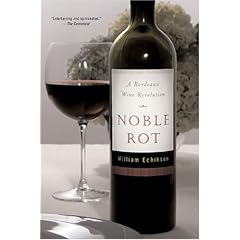 A stench wafts among the pricey vineyards of Bordeaux. According to Noble Rot by William Echikson, the stink comes from a cultural gangrene eating away at an arrogant and outmoded aristocracy so far into denial that it can’t see the mortal danger that corrodes it from within.
In the wine world, the term "noble rot" refers to a specific type of desirable mold that allows grapes to produce some of the world's most desirable and expensive sweet wines with Bordeaux's Château d'Yquem at the pinnacle. But Echikson uses the term as a metaphor for a syndrome of cultural and enological afflictions that have turned this august wine region on its Gallic nose. The fact that Château d'Yquem plays a key role makes the metaphor doubly relevant.
The obscure and irrelevant Classification of 1855 stars as the lead pathogen in Noble Rot. As Echikson points out, the old guard in Bordeaux still clutch at the 1855 classification in a last-ditch effort to sell inferior wine at very high prices to gullible snobs who crave tony labels. Indeed, this 1855 list was never about quality from the beginning, but about price and prestige. Not coincidentally for this book, Château d'Yquem came out on the very top of that listing.
Leading the revolution against the established order are les garagistes, a feisty band of winemakers, mostly from St.-Emilion and environs who, zut alors!, think that Bordeaux's over-priced, thin, musty swill should give way to quality wine produced through proper vineyard management and winemaking techniques. While there are some larger, well-financed operations in this movement, most have been labeled garagistes after a number of prominent winemakers who literally began in their garages and produced wines that sell at hundreds of dollars a bottle at retail.
The fact that many unclassified garagiste wines are now selling at far greater prices than those with a noble, classified château on the label has outraged the establishment which, in Marie Antoinette fashion, scream, "Let them drink plonk!"
Echikson gives the reader a very readable, enjoyable sand factually grounded account of how the upstart garagistes first tried to change the ossified classifications which stood like the Maginot Line between them, formal recognition and the establishment's pricing and sales system. When that failed, they simply swept around the flanks, establishing alternate pricing, sales and distribution channels that cut the old guard off like la guillotine.
Noble Rot could easily have been like most wine books: morphine for the soul, filled with geek-speak, pedantically self-important and impenetrable prose suitable only for treating people with a sleep disorder. Yet Echikson avoids this and has produced an accessible, thoughtful book so filled with interesting material about the business, the winemaking and the culture that it begs to be sipped and contemplated rather than quaffed.
What makes the book so engaging is the way that Echikson spins his story by following some of the key people on both sides of the movement, leading us through the conflicts, offering context and illuminating quotes that promote understanding.
We have the challengers: true garagistes such as Michel Gracia and well-heeled newcomers like Florence Cathiard of Château Smith-Haut-Lafite who are bound by a passion for great wine regardless of classification. On their side are avant garde merchants like Jeffrey Davies, modern wine consultants like Michel Rolland and Denis Dubourdieu and well-known wine critic Robert Parker.
The old guard sees evil in the fact that Davies and Parker are American as are many of the new vineyard and winemaking practices is evidence, according to the old guard, that this was "part of a grand conspiracy to destroy France."
Echikson aptly shows that the French don't seem to need any outside help to destroy their country since government regulations, a refusal to modernize, a pervasive rear-view mirror on progress and a general xenophobia are doing a great job without American intervention.
Noble Rot uses this attitude as one of the major manifestations of denial that keeps the decadent aristocracy from addressing the real issues, which is why American wine regularly out-scores French wine in France and that top global honors for that icon of French culture, the baguette, has gone to one of my local Sonoma bakeries on more than one occasion.
Commanding the defense of the old order is Château d'Yquem's Alexandre Lur-Saluces. Noble Rot details his decades of subterfuge, double-dealing, and attempts to cheat family members out of their rightful ownership and control of Château d'Yquem all the while running the place into the ground. The tale, told through a combination of interviews and extracts from court cases paints a gothic image that would never have been believable even on Falconcrest.
The old guard cast would not be complete without the context that most of Bordeaux's old guard were Vichy supporters and Nazi collaborators who received many a fascist pat on the back for shipping Jews off to the gas chambers, something that grand cru lovers might want to keep in mind.
Noble Rot begins with many threads which Echikson skillfully weaves together in the last part of the book to form a unified, disturbing and yet optimistic tapestry. As the author of wine books, I have visited Bordeaux on a number of occasions and met many of the people Echikson writes about. I found that after reading Noble Rot, I had a far more coherent framework on which to hang my episodic visits and knowledge.
By Lewis Perdue
California Vintners Still Delusional

When Lewis Perdue's book, The Wrath of Grapes hit bookstores in 1999, he predicted a massive glut of wine would sweep through California and hammer wine prices starting in 2000/2001.
The wine industry responded like like stoners who've been smoking their shorts. "Glut? Ain't gonna be no stinkin' glut!"
Jay Palmer at Barron's wrote a detailed, well-documented article on this and came to the same conclusion. The wine industry mounted a massive PR blitz aimed at neutralizing Palmer, Perdue and anyone else who dared look at the statistics. Brokerage analysts played their puppet roles well, mouthing corporate press releases and failing to look at the facts.
They were all treading water or floundering when the predicted glut hit in 2001. Right on schedule.
And every year, year after year, they pronounce the end of the glut. Only, no one ever uses the "G" word.
This year is no different.
Premier Pacific Vineyards, a Napa-based vineyard investment firm issued a rose-tinted report this week taking about the decline in "non-bearing" vineyard plantings and implying that, somehow, this was yet another harbinger of good times ahead and even hinting at shortages.
Bull feathers!
It's true that non-bearing acreage can help foretell future prospects. It takes a newly planted vineyard three to five years to begin production. But if you're savvy and take your own look at the stats, you'll see that the numbers reported by the U.S. Department of Agriculture don't show the flood of California wine ending anytime soon. It just shows that the insane rush to plant new vineyards has decreased from delusional to merely out of touch with reality.
The USDA's 2007 Grape Acreage Report indicates that non-bearing acres decreased from 47,000 acres to 43,000 acres. WhoopieDOOO! Sure, you can talk about a, 8.5 percent decline. But the REAL story lies in the acres still producing enough wine to keep the Two Buck Chuck tsunami flowing.
The last time that California wine production came close to a balance with demand was 1995-96 when the state had about 300,000 acres of bearing wine grapes. Feloniously optimistic projections about demand from pump-and-dump artists and those standing to profit from the expansion of vineyards created a planting spree.
The 2007 Grape Acreage Report shows California with 480,000 acres, the same as 2006. This comes despite vineyards being ripped out and grapes rotting on the vines, even in premium areas of Napa and Sonoma Valley.
The reality remains that California has, probably, two-thirds-MORE acres of wine vineyards than it needs, a good portent for regular wine consumers needing something to ease the pain of oil and real-estate prices.
More factors aggravate the situation for vineyard owners, the most important being a worldwide glut of wine which has helped boost the market share of imports from about 12 to 15% in the mid-1990s to about double that today.
Significantly, California crushed about 3.7 million tons of wine grapes in 2007, according to the USDA. At the current levels of consumption and imports, that's probably 750,000 tons higher than supply and demand would merit.
Wines wizards of unreality will respond that those overall numbers don't really apply to the haute-appellation wines of Napa and Sonoma. More bullfeathers!
This wine, Castello Da Vinci, is a negociant bottle, filled with a Bordeaux blend from Napa Valley's trendiest appellations. The highly, highly respected winery that made the wine sold it for more than $100 per bottle. But they had 30,000 gallons of it they couldn't sell. So it was shopped on the bulk market for about. Some of it ended up in the Castello Da Vinci bottle and sold for $25. About $5 of that went for wine. Another $3 for the label, bottle and all other costs.
Napa is not immune no matter how must they protest.
DISCLOSURE: Castello Da Vinci is Lewis Perdue's own wine, created by for a character in my current novel, Perfect Killer. Sourcing the wine on the bulk market confirmed everything I had known anecdotally about prices and the availability of very fine wines.
Subscribe to:
Posts (Atom)

 Posts


